Overview
A residential construction company came to us with a Google Ads account that was generating leads, but at a high and inconsistent cost. With a monthly ad spend of approximately $5,000, the account had potential, but its structure was preventing it from performing efficiently.
Over a 90-day optimization period, we rebuilt the account from the ground up. By simplifying the structure, aligning ads with user intent, and improving conversion tracking, we transformed the campaign into a more efficient and scalable lead generation system.
The result was a significant increase in lead quality and a reduction in cost per lead by more than 50%.
The Starting Point
When we first reviewed the account, the issue wasn’t demand. It was structure.
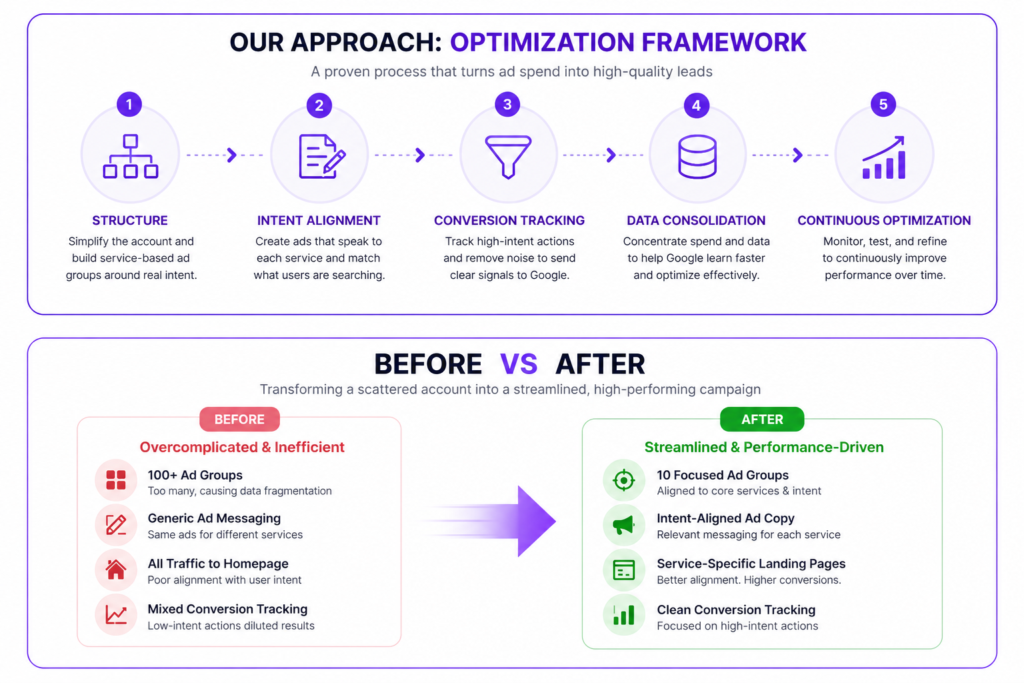
The account contained more than 100 ad groups, many of which targeted nearly identical keyword variations. This level of fragmentation diluted both budget and performance data, making it difficult for Google to determine which searches were actually driving results.
Ad messaging was also overly generic. Users searching for different services like remodeling, drywall, or general contracting were often shown the same ads. This reduced relevance and lowered engagement.
In addition, all traffic was being directed to a single homepage. While not inherently wrong, this approach requires highly refined targeting and messaging to work effectively. In this case, it created friction and reduced conversion efficiency.
Finally, conversion tracking lacked clarity. Low-intent actions were mixed with real lead signals, making it difficult for the system to optimize toward meaningful outcomes.
Our Approach
We focused on rebuilding the account with a clear objective: improve efficiency by aligning structure, targeting, and data with real user behavior.
Account Consolidation and Structure
The first step was reducing unnecessary complexity.
We consolidated the account from over 100 ad groups down to 10 focused, intent-driven groups. Each ad group was built around a core service category, such as general contractor services, renovation and remodeling, bathroom repair, drywall services, and deck construction.
This change concentrated both budget and performance data into fewer, stronger segments. As a result, Google was able to learn faster and make more accurate optimization decisions.
Service-Based Campaign Strategy
Rather than organizing campaigns around keyword variations, we restructured them around actual services that customers search for.
This meant separating high-level contractor searches from service-specific queries, and isolating categories like drywall and deck construction where performance justified it.
By aligning campaigns with real project types, we improved targeting precision and created a structure that can scale over time.
Ad Copy and Intent Alignment
We rewrote ad copy across the account to directly match search intent.
Previously, users searching for different services were seeing nearly identical messaging. After restructuring, each ad group featured tailored headlines and descriptions specific to the service being searched.
This improved click-through rate and helped pre-qualify users before they reached the site, resulting in higher-quality traffic.
Conversion Tracking Optimization
We refined conversion tracking to focus on meaningful business outcomes.
Instead of optimizing toward a mix of low-value interactions, we prioritized high-intent actions such as contact form submissions and qualified phone calls.
This gave Google a much clearer signal of what constitutes a successful outcome, allowing the algorithm to optimize more effectively.
Landing Page Alignment
We improved the alignment between ads and landing pages.
Instead of sending all traffic to a single homepage, we began directing users to more relevant service-specific pages. This reduced friction and made it easier for visitors to find the information they were looking for.
Even without building entirely new landing pages, this adjustment improved user experience and increased conversion rates.
Data Consolidation and Algorithm Learning
One of the most impactful changes was improving how data was fed into the system.
By reducing fragmentation and focusing on high-quality conversion signals, we allowed Google to exit its learning limitations and begin optimizing efficiently.
This is where the majority of performance gains were realized. Not just from better ads, but from better data.
Continuous Optimization
Throughout the 90-day period, we continuously monitored and refined performance.
We adjusted bids, paused underperforming segments, and reallocated budget toward higher-performing areas. This iterative approach ensured that improvements were sustained and built upon over time.
The Results (After ~90 Days)
Before and after results from the 90-day optimization period.
| Metric | Before | After | Change |
|---|---|---|---|
| Cost Per Click | $8.66 | $12.69 | +46% |
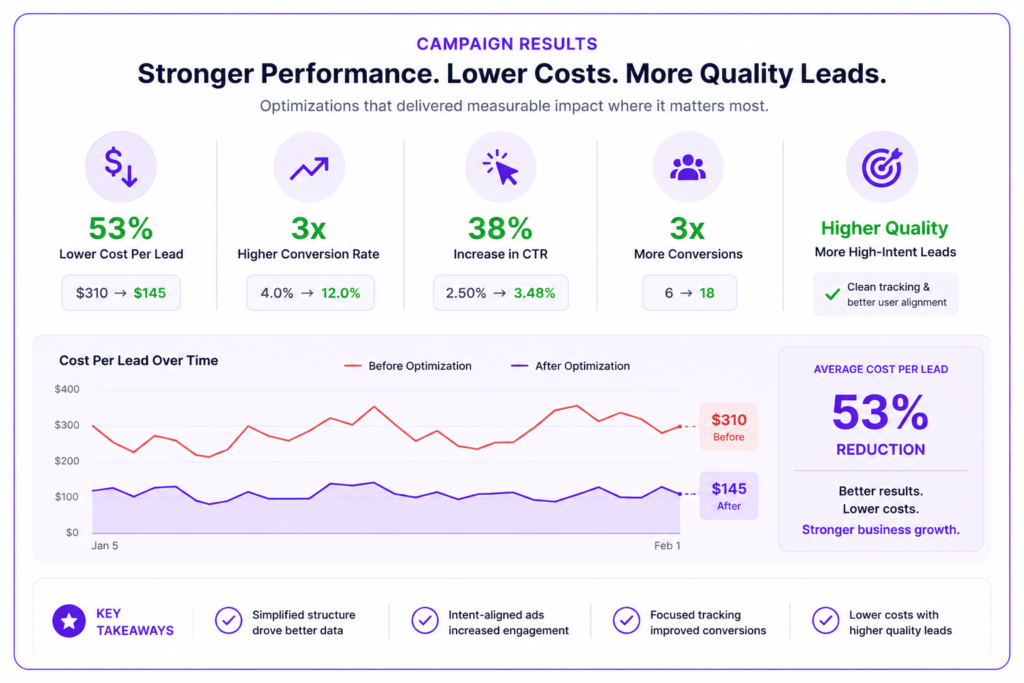
| Click-Through Rate | 2.41% | 3.34% | +38% |
| Conversion Rate | 2.79% | 8.78% | +215% |
| Cost Per Lead | $310 | $145.78 | -53% |
What Changed
Higher Engagement from More Relevant Ads
Click-through rate increased significantly, indicating that ads are now better aligned with what users are searching for. More relevant messaging is attracting more qualified clicks.
Stronger Conversion Performance
Conversion rate more than tripled, meaning a much higher percentage of visitors are turning into leads. This reflects improved traffic quality and a more relevant user experience.
Lower Cost Per Lead
Cost per lead dropped by more than 50%, allowing the same budget to generate significantly more opportunities. The campaign is now far more efficient and scalable.
Shift Toward Higher-Intent Traffic
While cost per click increased, this reflects a strategic shift toward more competitive, higher-intent searches. These clicks are more valuable because they are more likely to convert.
Key Takeaways
The primary issue with this account was not budget or demand. It was structure.
Simplifying the account allowed Google to learn faster and optimize more effectively.
Focusing on user intent instead of keyword volume resulted in higher-quality traffic.
Accurate conversion tracking ensured that optimization was based on real business outcomes.
Final Thoughts
This case study demonstrates how a Google Ads account can appear to be working while still leaving significant performance gains on the table.
By restructuring the account, aligning campaigns with real customer intent, and improving conversion signals, we transformed it into a predictable and scalable lead generation system.
Looking to Improve Your Google Ads Performance?
If your campaigns are generating leads but at a high cost, the issue may not be your budget. It may be how your account is structured.
We help businesses identify inefficiencies, rebuild campaigns, and turn ad spend into consistent, high-quality opportunities. Get a free Google Ads audit today for your account.